
The word resilience arrives in my inbox about twice a week, and it almost never means what the dictionary says. When an Irish HR manager emails me asking for a resilience talk, the thing underneath the word is usually one of about four situations, and knowing which one you are in is most of the work of picking a speaker.
What do Irish companies mean when they ask for a resilience keynote?
A request for a resilience keynote in Ireland usually means one of four things. The team has been through a restructure or a bad year. Absence and burnout have become visible to the board. Managers are struggling and nobody wants to say so. Or there is a wellbeing week in the calendar and a slot that needs filling well.
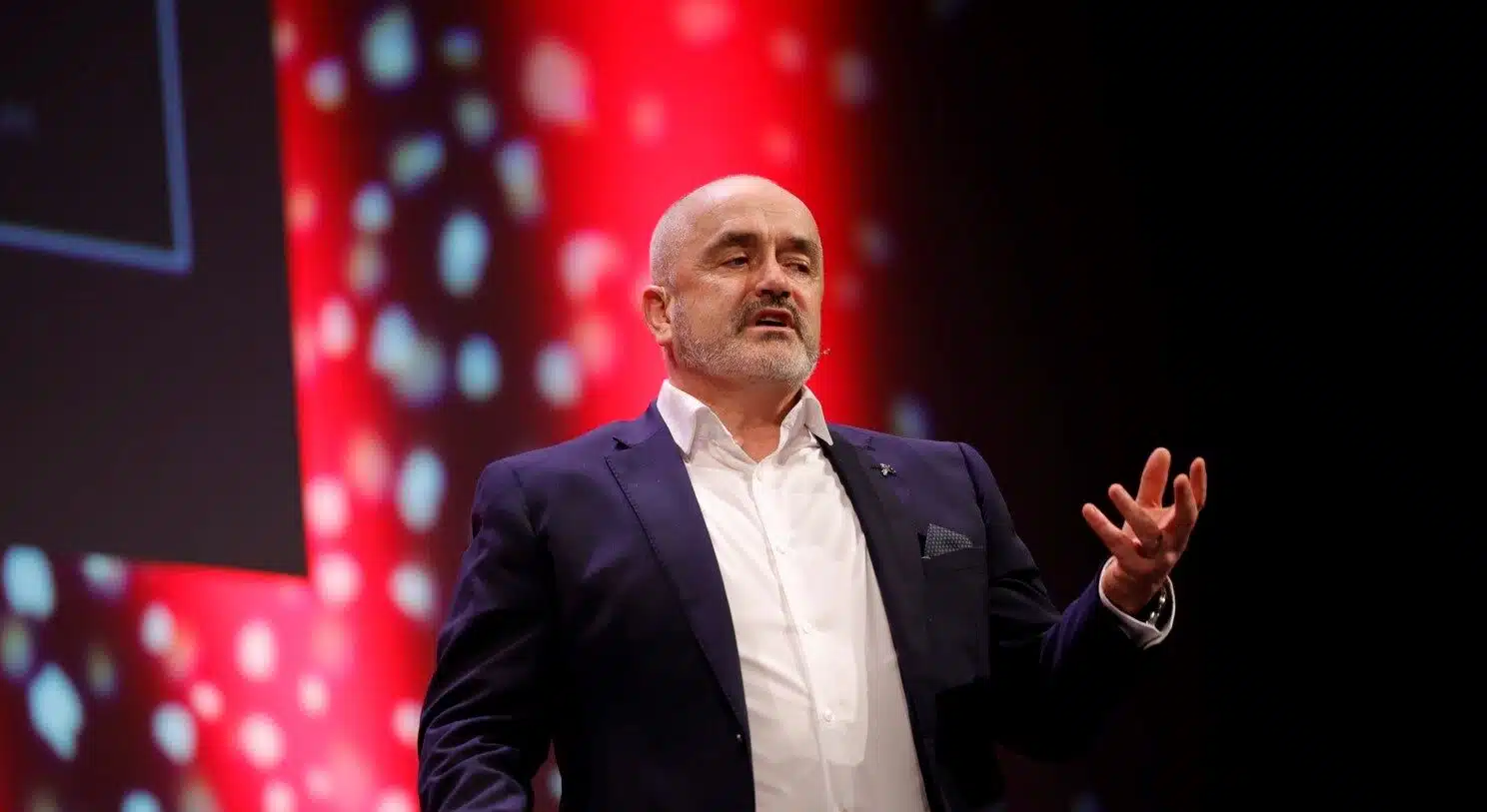
Those four need genuinely different talks. I am Enda O’Doherty, a resilience keynote speaker based in Waterford, and I have got this wrong before by assuming. A team six weeks after a redundancy round does not want to hear about summits. They want permission to say that the last few months were rough, and then something practical they can use on Monday. A wellbeing week audience is a different job entirely, because half of them chose to be there and half were told to attend.
Resilience has quietly become a business word rather than a wellness word. Nobody is booking a talk to make people feel nice for an hour any more. They are booking it because something is going wrong and they need it named out loud by somebody from outside the building.
- A team recovering from restructure, redundancy or a bad trading year
- Absence and burnout figures that have become visible to the board
- Middle managers under strain that nobody has named yet
- A wellbeing week slot that has to be filled properly
Who are the main resilience speakers in Ireland?
Ireland has a small but strong group of speakers working on resilience. Mark Pollock, Sinead Kane, Damian Browne and Enda O’Doherty come at it through physical adversity and endurance. Professor Brendan Kelly, Dr Sabina Brennan and Dr Eddie Murphy come at it clinically. Richie Sadlier and Niall Breslin bridge sport and mental health. The two groups are not interchangeable.
If your audience is sceptical, technical or senior, and they have sat through three wellbeing sessions already this year, the lived experience group tends to land better, because it is harder to argue with somebody describing what actually happened to them. If your organisation needs the talk to carry research authority, or it is going in front of a clinical or medical audience, the psychologists and psychiatrists are the safer pick and I will say so to your face. I have sent work to some of these people when a brief was clearly not mine.
What I would avoid is booking on story size. The most extreme story in the room is not automatically the most useful one. I have watched an audience be impressed by somebody for fifty minutes and take nothing home, and I have watched a quieter talk change how a management team spoke to each other for a year. Impressive and useful are different products.
Is a resilience keynote just telling people to toughen up?
No, and if it is, do not book it. A resilience talk that puts the whole burden on the individual will fail in an Irish workplace in 2026, because employees know the difference between support and blame. CIPD Ireland’s HR Practices survey, published in May 2026, found mental health is now the leading cause of absence in 51% of organisations. That is not a personal grit problem.
This is the thing I am most careful about. If I stand up in front of three hundred people whose workload is genuinely unmanageable and tell them the answer is a better mindset, I have insulted them, and they will quote it back to their HR manager for months. The same survey found 28% of Irish organisations reporting increased absence levels, and 80% having difficulty retaining people. European survey data gathered through EU-OSHA and summarised by Ibec in February 2026 put severe time pressure or work overload at 44% of Irish workers.
So what I actually say is that there are things an organisation has to fix, and there are things an individual can control, and confusing the two makes both worse. That distinction is most of my talk. It is also the reason HR people tend to relax about ten minutes in, once they realise I am not going to make their staff the problem.
What does a resilience talk realistically change?
A keynote can shift language, permission and intent. It gives a team shared words for something they have been carrying privately, it makes it acceptable to say so, and it usually produces a handful of practical changes in the following weeks. What it cannot do is fix a workload problem, replace a manager development programme or substitute for an employee assistance service.
I say this in proposals now, because overselling it is how speakers get a bad name. If the underlying issue is that a department is thirty per cent under-resourced, my hour will be the most enjoyable part of a bad year and nothing more. Where a talk does earn its fee is as the opening of something. Ibec puts the cost of poor mental health to Irish employers at up to €2,000 per employee per year, and organisations that treat a keynote as the front door to a programme rather than the programme itself get considerably more out of it.
How should I brief a resilience speaker?
Tell the speaker four things before anything else. What has happened to this team in the last twelve months. Who is in the room and whether they chose to attend. What you specifically do not want mentioned. And what you want to be different on Monday morning.
That last one changes the talk more than anything. If you tell me you want managers to start asking one better question in their one to ones, I will build towards that and leave them with it. If you tell me nothing, you will get my best general talk, which is fine, and which is not what you are paying for.
The thing you do not want mentioned matters too. Sometimes there has been a death. Sometimes there is a redundancy process running that has not been announced. I would far rather know, and every keynote I do includes a call before the event for exactly this reason.
Do you need clinical qualifications to speak about resilience?
No, but you need to be clear about which one you are. Enda O’Doherty speaks from lived experience of bereavement, mental health difficulty and addiction, not as a clinician, and says so from the stage as well as in writing. A speaker who blurs that line is a risk to your organisation, not just to themselves.
There is room for both. The mistake is buying one and getting the other. If your governance people or your occupational health team need somebody with letters after their name, that is a legitimate requirement and it rules me out, and I would rather tell you that in the first email than in the room.
If you are reading this and you are not in a good place yourself, rather than booking for others, please talk to your GP, or ring the Samaritans on 116 123. They answer through the night and there is no bother at all in ringing them.
Key takeaways
- ✓A request for resilience usually hides one of four situations, and each needs a different talk
- ✓Irish resilience speakers split into lived experience and clinical, and the two are not interchangeable
- ✓Mental health is the leading cause of absence in 51% of Irish organisations, per CIPD Ireland, May 2026
- ✓A keynote shifts language, permission and intent, and cannot fix workload or resourcing
- ✓Brief the speaker on the last twelve months, the audience, the no go areas and the Monday morning goal
Frequently Asked Questions
Who is a good resilience speaker for an Irish corporate audience?
It depends on whether the room needs lived experience or clinical authority. Enda O’Doherty, based in Waterford, works from lived experience of bereavement, mental health difficulty and addiction, and suits sceptical or senior corporate audiences. Clinical audiences are better served by a psychologist or psychiatrist.
How long is a resilience keynote?
One hour to one and a half hours is standard for an Irish corporate keynote, and it can be adjusted to fit a conference agenda.
What does a resilience keynote cost in Ireland?
Between roughly €2,000 and €10,000, depending on audience size, location, duration and format.
Will a resilience talk reduce absenteeism?
No speaker should promise that. A keynote changes language, permission and intent, and works best as the opening of a wider programme rather than as the programme itself.
Can a resilience keynote be delivered online?
Yes. Enda O’Doherty delivers online and hybrid sessions regularly for Irish and international organisations.
Bring this message to your team
Enda O’Doherty is a resilience and mental health keynote speaker based in Waterford, working with organisations across Ireland and internationally on resilience, wellbeing and performing under pressure.


